
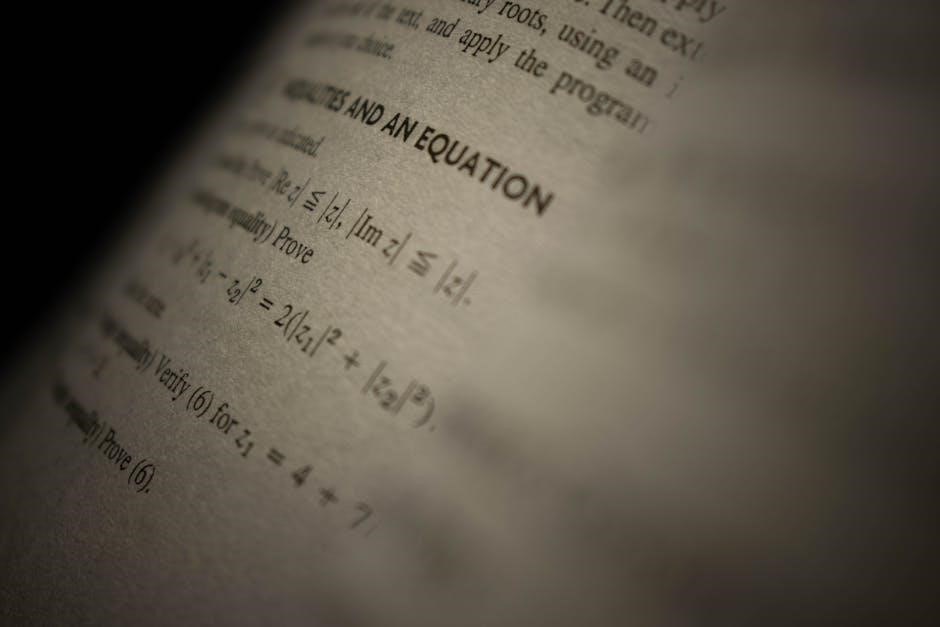
Advanced calculus books in PDF format offer students and researchers accessible, portable learning resources. Digital libraries now host classic texts like Widder’s 1947 edition.
Franklin’s “Methods of Advanced Calculus” and Weikard’s lecture notes are also readily available, fostering broader access to crucial mathematical concepts.
The Growing Demand for Digital Calculus Resources
The surge in demand for digital advanced calculus resources, particularly PDFs, reflects a significant shift in modern learning preferences. Students increasingly favor the convenience and portability offered by electronic textbooks. Access to digitized versions of foundational works, like those from the Digital Library of India, democratizes education.
Researchers benefit from quick searches within PDFs and easy citation capabilities. The availability of scanned copies, such as Widder’s “Advanced Calculus” (1947), and contemporary lecture notes like Weikard’s, caters to diverse learning styles. This trend is fueled by the increasing affordability of devices and reliable internet access, making advanced mathematical knowledge more attainable globally.
Why Choose a PDF Format?
Selecting PDF format for advanced calculus books provides numerous advantages for students and professionals. PDFs ensure consistent formatting across various devices, preserving the original layout of texts like Franklin’s “Methods of Advanced Calculus”. Their portability allows offline access, crucial for study without internet connectivity.
PDFs support annotation features, enabling direct note-taking and highlighting within the text. Digital copies are often more affordable than physical books, and readily available through repositories like IIAP and Osmania University. Furthermore, PDFs contribute to environmental sustainability by reducing paper consumption, making them a practical and eco-friendly choice for accessing complex mathematical literature.

Key Books in Advanced Calculus Available as PDFs
Several foundational texts in advanced calculus are now accessible as PDFs, including Widder’s “Advanced Calculus”, Franklin’s “Methods”, and Weikard’s comprehensive lecture notes.
David V. Widder’s “Advanced Calculus” (1947)
David V. Widder’s “Advanced Calculus,” originally published in 1947 by Prentice Hall, remains a significant resource, now widely available in PDF format through digital libraries like the Digital Library of India (DLI).
This classic text, totaling 453 pages, is out of copyright, allowing for free access and distribution. The DLI accessioned it on July 7, 2015, providing a stable digital record.
Widder’s work comprehensively covers fundamental concepts, notably Rolle’s Theorem, forming a cornerstone of real analysis. Its enduring value lies in its rigorous treatment and clear exposition of advanced calculus principles, making it a valuable asset for students and researchers alike.
The barcode identifier is 99999990012814.
Availability and Access through Digital Libraries
David V. Widder’s “Advanced Calculus” (1947) enjoys robust availability through several digital libraries, notably the Digital Library of India (DLI). The DLI provides access via a persistent URI: http://www.new.dli.ernet;in/handle/2015/176713.
This accessibility is enhanced by the book’s out-of-copyright status, permitting free downloads and usage. Scanned at IIAp, Bangalore, the PDF format ensures broad compatibility across devices.
Researchers and students can readily locate and utilize this valuable resource, circumventing the limitations of physical copies. The DLI’s digital preservation efforts guarantee long-term access to Widder’s foundational work, fostering continued study and scholarship in advanced calculus.
Accession date is July 7, 2015.
Key Concepts Covered: Rolle’s Theorem
David V. Widder’s “Advanced Calculus” dedicates significant attention to foundational theorems, prominently featuring Rolle’s Theorem. This theorem, a cornerstone of differential calculus, establishes a relationship between the roots of a function and its derivative.
Widder’s treatment likely explores the theorem’s prerequisites – continuity and differentiability – alongside its geometric interpretation. The book probably details the theorem’s application in proving other crucial results, such as the Mean Value Theorem.
Understanding Rolle’s Theorem is vital for grasping the core principles of real analysis and its applications. The text’s detailed exposition, available in PDF format, allows for focused study of this essential concept, aiding students in building a strong foundation in advanced calculus.
The subject keyword is Rolles Theorem.
Total Pages and Publication Details
David V. Widder’s “Advanced Calculus,” originally published by Prentise Hall in 1947, is a substantial work, comprising a total of 453 pages. This extensive length reflects the book’s comprehensive coverage of advanced calculus topics.
The digital PDF version, accessioned on July 7, 2015, and available through the Digital Library of India, preserves the original publication’s content. The book’s barcode is 99999990012814, and its original path within the digital library is /data/upload/0012/819.
Being out of copyright, the PDF is freely accessible for study and research; The scanning center responsible for digitizing this edition was IIAp, Bangalore, ensuring a high-quality digital reproduction of this classic text.
Franklin’s “Methods of Advanced Calculus”
Franklin’s “Methods of Advanced Calculus” stands as a significant contribution to the field, published by McGraw Hill Book Company Inc. This resource is now accessible in PDF format through the Digital Library of India, broadening its reach to students and researchers globally.
The book’s subject classification encompasses Mathematics and Natural Sciences, specifically within Fundamental and General Considerations of Mathematics. Its digital republication ensures preservation and wider distribution of this valuable text.
The PDF version carries a Copyright Permitted designation, allowing for educational use and study. Sourced from Osmania University, this digital edition provides a convenient and cost-effective alternative to physical copies, furthering access to advanced mathematical knowledge.
Publisher and Digital Repositories
Franklin’s “Methods of Advanced Calculus” originally published by McGraw Hill Book Company Inc., has benefited from digital preservation efforts. The Digital Library of India serves as a primary repository, offering free access to the PDF version of this classic text.
Osmania University contributed to the digitization process, ensuring the book’s longevity and accessibility. Other potential repositories may include university libraries and online archives dedicated to mathematical literature.
The availability of this PDF through these digital platforms democratizes access to advanced calculus resources, particularly for students and researchers in regions with limited library access. This digital format facilitates convenient study and research, promoting wider engagement with the subject matter.
Subject Classification: Mathematics & Natural Sciences
Franklin’s “Methods of Advanced Calculus” firmly resides within the disciplines of Mathematics and Natural Sciences. More specifically, it’s categorized under Fundamental and General Considerations of Mathematics, laying the groundwork for advanced studies in related fields.
This classification reflects the book’s core focus on rigorous mathematical principles essential for understanding phenomena in physics, engineering, and other scientific domains. Advanced calculus provides the analytical tools necessary for modeling and solving complex problems in these areas.
Its interdisciplinary nature makes it a valuable resource not only for mathematics students but also for those pursuing degrees in the natural sciences, highlighting the foundational role of calculus in scientific inquiry and problem-solving.

Rudi Weikard’s Lecture Notes (MA 440/540 & 441/541)
Rudi Weikard’s lecture notes, designated MA 440/540 & 441/541, represent a valuable resource for advanced calculus study. Based on the work of G. Stolz and G. Weinstein, these notes offer a focused approach to key concepts.
Notably, the August 3, 2022 version is made available under a CC-BY-NC-SA license, promoting open access and encouraging responsible use. This licensing allows for sharing and adaptation, but requires attribution and non-commercial application.
The notes cover a range of topics, visually represented with graphs like log(x), and provide a solid foundation for students navigating the complexities of advanced mathematical analysis. They are a testament to collaborative academic effort.
Open Access and Licensing (CC-BY-NC-SA)
Rudi Weikard’s lecture notes exemplify the benefits of open access publishing in the realm of advanced calculus resources. The CC-BY-NC-SA license, specifically, governs the usage and distribution of this valuable material.
This Creative Commons license allows anyone to share, adapt, and build upon the work, even commercially, as long as appropriate attribution is given to the original author, Rudi Weikard. However, the license stipulates non-commercial use and requires that derivative works are shared under the same license.
This promotes collaborative learning and wider dissemination of knowledge, making advanced calculus education more accessible to a global audience, fostering a community of mathematical exploration.
Content Focus and Version Date (August 3, 2022)
Rudi Weikard’s lecture notes, specifically for courses MA 440/540 & 441/541, provide a comprehensive overview of advanced calculus principles. The content builds upon foundational concepts, likely referencing earlier work by G. Stolz and G. Weinstein, as indicated in the notes themselves.
The notes cover a range of topics essential to a thorough understanding of the subject, potentially including real analysis, multivariable calculus, and related mathematical areas. The inclusion of a graph depicting log(x) suggests a focus on functions and their properties.
Importantly, the version date of August 3, 2022 signifies a relatively recent update, ensuring the material reflects current pedagogical approaches and mathematical standards.

Essential Topics Covered in Advanced Calculus Books
Advanced calculus texts systematically explore limits, continuity, differentiation, integration, sequences, series, and multivariable calculus – building a robust mathematical foundation for further study.
Limits and Continuity
Limits form the bedrock of calculus, defining how functions behave as their inputs approach certain values. Advanced calculus books rigorously explore limit definitions, theorems, and techniques for evaluating them, often utilizing epsilon-delta arguments for precise proofs.
Continuity, closely linked to limits, examines functions without breaks or jumps. Texts detail different types of discontinuities and their implications. Understanding these concepts is crucial, as they underpin differentiation and integration.
Rolle’s Theorem, frequently covered, demonstrates a relationship between a function’s values and its derivative, providing a foundational tool for further analysis. These chapters often include numerous examples and exercises to solidify comprehension.
Mastery of limits and continuity is essential for navigating more complex calculus topics.
Differentiation
Differentiation, a core component of advanced calculus, explores the rate of change of functions. Advanced calculus books meticulously cover derivative definitions, rules (product, quotient, chain rule), and applications, building upon the foundation of limits and continuity.
These texts delve into higher-order derivatives, partial derivatives (in multivariable calculus), and techniques like implicit differentiation. Rolle’s Theorem and the Mean Value Theorem are often revisited in this context, demonstrating connections between function values and derivatives.
Applications extend to optimization problems, curve sketching, and related rates. Numerous examples and practice problems are provided to reinforce understanding and develop problem-solving skills.
A strong grasp of differentiation is vital for tackling advanced mathematical and scientific challenges.
Integration
Integration, the inverse operation of differentiation, is a cornerstone of advanced calculus. Advanced calculus books systematically present techniques for evaluating definite and indefinite integrals, including substitution, integration by parts, and trigonometric integrals.
These resources explore the Fundamental Theorem of Calculus, linking integration and differentiation, and its implications for solving differential equations. Improper integrals and their convergence are also thoroughly examined.
Applications of integration are highlighted, encompassing areas like finding areas, volumes, arc lengths, and surface areas. PDF versions often include detailed worked examples and exercises to solidify comprehension.
Mastering integration is crucial for success in various scientific and engineering disciplines.

Sequences and Series
Sequences and Series form a vital component of advanced calculus, building upon the foundations of limits and continuity. Advanced calculus books delve into the convergence and divergence of sequences, employing tests like the ratio and root tests to determine behavior.
Infinite series, including power series and Taylor series, are rigorously explored, alongside their applications in approximating functions. Understanding uniform convergence is emphasized, crucial for justifying term-by-term differentiation and integration.
PDF versions of classic texts often provide extensive problem sets to practice these concepts. Mastery of sequences and series is essential for advanced mathematical analysis.
These topics underpin many areas of mathematics, physics, and engineering.
Multivariable Calculus

Multivariable Calculus extends calculus concepts to functions of several variables, a cornerstone of advanced mathematical study. Advanced calculus books in PDF format meticulously cover partial derivatives, gradients, directional derivatives, and multiple integrals.
Vector fields, line integrals, surface integrals, and theorems like Green’s, Stokes’, and the Divergence Theorem are thoroughly examined. These tools are essential for modeling physical phenomena in three dimensions and beyond.
Optimization problems involving multiple variables, including Lagrange multipliers, are also detailed. Accessing these concepts through digital texts allows for convenient study and practice.
Understanding multivariable calculus is crucial for fields like physics, engineering, and economics.

Finding and Evaluating Advanced Calculus PDFs
Locating advanced calculus PDFs requires utilizing reputable digital libraries and online repositories. Always verify copyright permissions and assess the PDF’s quality.
Reputable Sources for PDF Downloads
Accessing advanced calculus books in PDF format necessitates utilizing trustworthy online platforms. The Digital Library of India (DLI), for instance, hosts digitized versions of classic texts like Widder’s “Advanced Calculus” (1947), offering open access under specific licensing terms.
University libraries, such as Osmania University, often provide digital repositories containing valuable resources. IIAP, Bangalore, is another scanning center contributing to the availability of these materials. Ensure the source is legitimate to avoid copyright infringements and malware risks. Prioritize platforms with clear usage rights and established reputations for academic integrity when seeking these PDFs.
Copyright and Usage Rights
Understanding copyright is crucial when downloading advanced calculus book PDFs. Widder’s “Advanced Calculus” (1947) is listed as “Out_of_copyright,” permitting broader usage. However, Franklin’s “Methods of Advanced Calculus” carries a “Copyright Permitted” designation, requiring careful adherence to licensing terms.
Weikard’s lecture notes utilize a CC-BY-NC-SA license, allowing sharing with attribution, non-commercial use, and similar licensing of derivatives. Always verify the specific rights associated with each PDF before distribution or modification. Respecting intellectual property ensures continued access to these valuable educational resources and supports authors’ rights.
Assessing the Quality of a PDF Book
Evaluating PDF quality is vital when sourcing advanced calculus books digitally. Check for clarity – scanned pages should be legible, without distortions or missing content. Verify completeness; note the total pages (e.g., Widder’s has 453) and ensure none are absent.
Assess the source’s reputation; downloads from established digital libraries (like the Digital Library of India) are generally more reliable. Look for proper formatting, accurate mathematical notation, and a clear table of contents. Poor quality PDFs can hinder learning, so prioritize well-maintained, trustworthy digital copies for effective study.

Tools for Working with Advanced Calculus PDFs
PDF readers and annotation software enhance study. Digital note-taking allows highlighting, commenting, and organization within advanced calculus books, improving comprehension and retention.
PDF Readers and Annotation Software
Effective study of advanced calculus PDFs requires robust software. Adobe Acrobat Reader DC remains a standard, offering basic viewing and annotation features. However, specialized tools elevate the experience.
PDF Expert (available on macOS and iOS) provides a streamlined interface for highlighting, underlining, and adding notes. Xodo is a free, cross-platform option with similar capabilities, including form-filling and signature support.
For more advanced annotation, consider LiquidText, which excels at organizing and connecting ideas within complex documents. These tools allow students to actively engage with advanced calculus books, fostering deeper understanding and facilitating efficient review of key concepts and theorems.
Digital Note-Taking Strategies
Studying advanced calculus PDFs benefits greatly from strategic digital note-taking. Avoid simply highlighting; instead, actively summarize concepts in your own words using annotation tools.
Employ a layered approach: color-code notes by topic (limits, differentiation, integration), and use symbols to denote important theorems or problem-solving techniques. Create a “concept map” within the PDF, linking related ideas visually.
Utilize external note-taking apps like OneNote or Evernote to expand on PDF annotations, working out practice problems and creating detailed summaries. Regularly review and refine these digital notes, transforming the advanced calculus book into a personalized learning resource.

Advanced Calculus Resources Beyond Books
Supplementing PDF textbooks with online courses, interactive tools, and practice problems enhances understanding. These resources solidify concepts learned from advanced calculus books.
Online Courses and Tutorials
Complementing advanced calculus books in PDF format, numerous online platforms deliver structured learning experiences. Platforms like Khan Academy and MIT OpenCourseWare provide video lectures, practice exercises, and interactive simulations covering core concepts.
These resources often break down complex topics into manageable segments, aiding comprehension. Coursera and edX host university-level courses taught by experienced instructors, offering a more formal learning path.
Tutorials focusing on specific techniques, such as integration by parts or series convergence tests, are also widely available. Utilizing these digital tools alongside PDF textbooks creates a dynamic and effective learning environment, catering to diverse learning styles and paces.
Interactive Calculus Tools
Alongside advanced calculus books in PDF format, interactive tools significantly enhance understanding and problem-solving skills. Wolfram Alpha serves as a powerful computational engine, capable of evaluating limits, derivatives, and integrals with ease, verifying solutions found in textbooks.
Desmos offers dynamic graphing capabilities, allowing visualization of functions and their behavior. GeoGebra combines geometry, algebra, calculus, and statistics in an interactive environment, ideal for exploring multivariable concepts.
These tools aren’t replacements for rigorous study with PDF resources, but rather valuable supplements. They facilitate experimentation, provide immediate feedback, and deepen conceptual grasp, making learning more engaging and effective.
Supplementary Materials and Practice Problems
Complementing advanced calculus books in PDF format, a wealth of supplementary materials exists online. Websites like Khan Academy provide video tutorials and practice exercises covering core concepts, reinforcing learning from texts like Widder’s or Franklin’s.
MIT OpenCourseWare offers complete course materials, including problem sets and solutions, mirroring university-level instruction. Paul’s Online Math Notes delivers concise explanations and worked examples, ideal for quick review.
Actively solving practice problems is crucial. Schaum’s Outlines provide extensive problem sets with detailed solutions, while university websites often host past exams. Utilizing these resources alongside PDF textbooks solidifies understanding and builds confidence.